Role of 3D Design in Exhibitions: Enhancing Impact
Standing out on a crowded trade show floor is never easy when competing brands from across Europe surround you at every turn. For marketing managers, the challenge is more than visual appeal—it is about shaping powerful visitor journeys that leave a lasting impression. 3D design brings exhibition spaces to life by merging digital and physical experiences, guiding how each attendee experiences your brand and story. This article offers practical insights into how innovative 3D exhibition design strategies can maximize your brand’s impact at international events.
Table of Contents
- What 3D Design Means For Exhibitions
- Key Types Of 3D Exhibition Stand Design
- How 3D Visualization Transforms Planning
- Workflow: From Concept To Exhibit Floor
- Common Pitfalls And How To Avoid Them
Key Takeaways
| Point | Details |
|---|---|
| 3D Design Enhances Visitor Experience | Effective 3D design controls the entire visitor experience, ensuring optimal spatial flow and engagement before physical construction begins. |
| Types of 3D Exhibition Designs | Choosing between modular systems, custom structures, or tech-integrated displays impacts flexibility, budget, and marketing objectives. |
| Precision in Planning | 3D visualization transforms planning by enabling detailed simulations and identifying potential issues before fabrication, leading to smoother setups. |
| Usability Testing is Crucial | Prioritize usability alongside aesthetics; conduct user testing in virtual reality to ensure interactive elements function intuitively. |
What 3D Design Means for Exhibitions
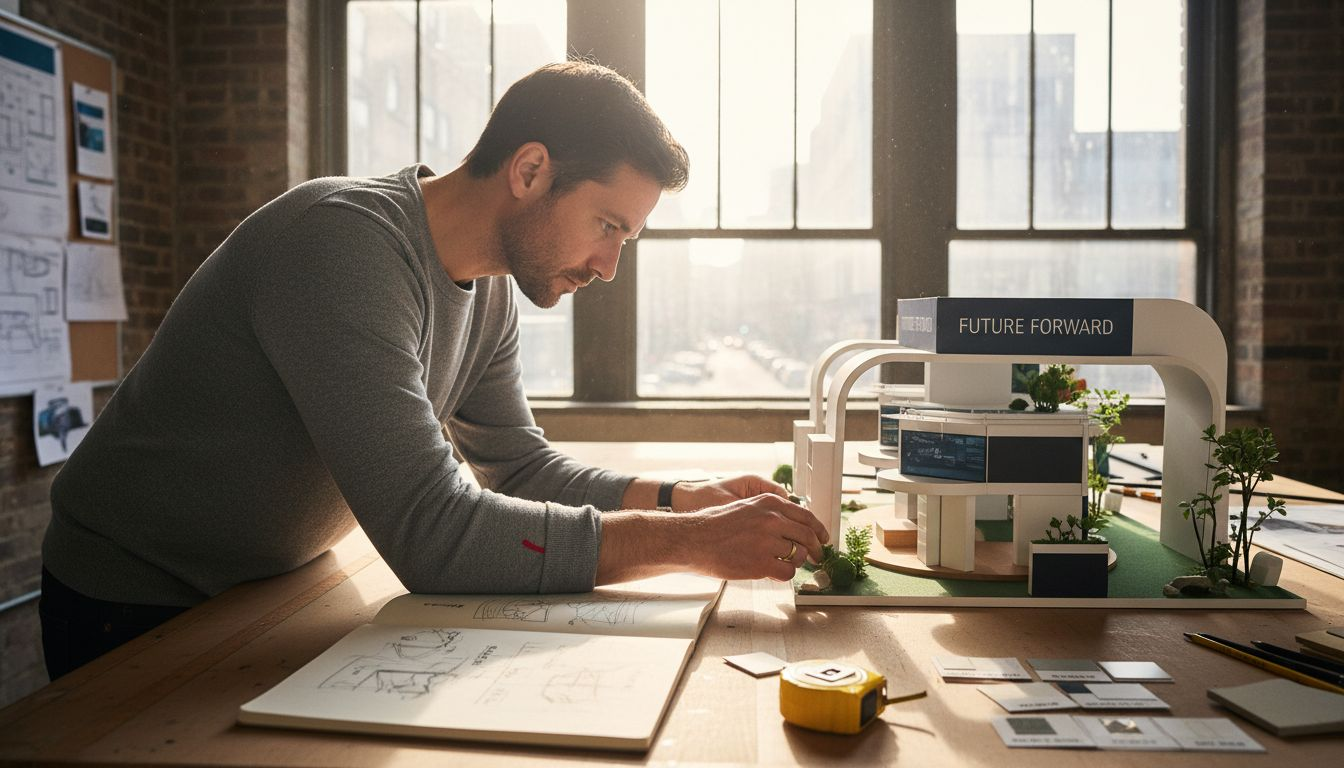
3D design fundamentally transforms how your exhibition communicates to visitors. It’s not just about creating a pretty visual or rendering something on screen before you build it. When you use 3D design effectively, you’re controlling the entire visitor experience: spatial flow, visual hierarchy, narrative arc, and how people actually move through your booth. This technology lets you make intentional decisions about every element before fabrication begins, reducing costly mistakes and ensuring your brand message lands exactly as intended.
The power of 3D design lies in its ability to bridge digital and physical spaces. Research confirms that interactive design technology, including 3D modeling combined with virtual and augmented reality, dramatically improves visitor engagement and information acquisition. Think of it this way: your booth becomes an immersive environment rather than a static display. When you design exhibition stands for maximum impact, 3D visualization allows you to test how materials, lighting, and layout work together in three dimensions. You can see sight lines from different vantage points, understand how color and texture interact under actual trade show lighting conditions, and identify spatial inefficiencies before committing resources to physical construction.
Beyond aesthetics, 3D design serves critical functional purposes. It determines spatial layout, influences visual hierarchy, and shapes how visitors interpret your narrative. For marketing managers overseeing European trade shows, this means you can validate whether your booth design actually supports your marketing objectives. Does the layout guide visitors naturally toward product displays? Can they move through without congestion? Are interactive elements positioned where they’ll receive foot traffic? These questions get answered in the 3D environment long before your booth stands at a Frankfurt or Amsterdam exhibition. The design encompasses not just how things look but how they function and how visitors interact with them, ultimately enhancing both the educational value of your presentation and the likelihood that attendees remember your brand.
Pro tip: Use your 3D design visualization to test multiple layout configurations before finalizing fabrication, ensuring you optimize booth traffic flow and visitor engagement pathways.
Key Types of 3D Exhibition Stand Design
3D exhibition stand designs break down into three main categories, each serving different strategic objectives at European trade shows. Modular systems give you flexibility and cost efficiency. These designs use standardized components that connect in various configurations, allowing you to adapt your booth layout for different venues without complete redesign. This approach works particularly well if you exhibit regularly at multiple shows throughout the year. Custom structural designs offer the opposite advantage: complete originality. When you need your booth to embody your brand’s unique identity or create a memorable architectural statement, custom 3D designs deliver that impact. Finally, technology-integrated interactive displays combine physical structures with digital elements like touchscreens, projection mapping, and augmented reality experiences. This category drives engagement because visitors don’t just observe your products; they interact with them, which dramatically increases information retention and brand recall.
Designers create these 3D models using CAD software, focusing on material selection, color schemes, lighting design, and spatial configuration to achieve both aesthetic appeal and functionality. For marketing managers, this means every design choice serves a purpose. The materials you choose affect durability and transportation costs. Your color scheme either reinforces brand recognition or clashes with it. Lighting placement either highlights product features or casts shadows that hide them. Spatial configuration either welcomes visitors into your booth or creates awkward dead zones. When you understand how these elements work together in 3D visualization, you make informed decisions that directly impact your return on exhibition investment.
The variety of design options means you can select an approach that aligns with your specific exhibition goals and marketing strategy. Maybe you’re launching a new product line and need a showstopper booth that stops foot traffic in its tracks. A technology-integrated custom design accomplishes that. Perhaps you’re exhibiting at four trade shows across Europe this year and need consistency without repetitive costs. A modular system makes sense. Or you might be testing a new market segment and want to measure booth performance before investing heavily in permanent infrastructure. A strategically designed modular booth lets you experiment with lower financial risk. Essential types of exhibition stands for trade shows offer different advantages depending on your timeline, budget, and strategic priorities.
Here is a comparison of the main types of 3D exhibition stand designs and their benefits:
| Design Type | Flexibility | Customization Level | Ideal For |
|---|---|---|---|
| Modular System | High, adapts to venues | Low, uses standardized parts | Frequent exhibitors at multiple shows |
| Custom Structure | Low, fixed layout | High, unique architecture | Strong brand expression, unique launches |
| Tech-Integrated | Moderate, tech adapts | High, interactive elements | Driving engagement and memorability |
Pro tip: Before finalizing your 3D design choice, map your exhibition schedule for the next 18 months and assess whether modular flexibility or custom impact better serves your marketing roadmap.
How 3D Visualization Transforms Planning
3D visualization fundamentally changes how you plan and execute exhibition projects. Instead of relying on 2D floor plans and imagination, you can now walk through your booth digitally before a single component gets fabricated. This capability shifts planning from guesswork to precision. You simulate different configurations, test traffic flow patterns, and identify spatial conflicts weeks before setup day. When you spot that your information desk blocks the main product display sightline, or that your demo station needs electrical access you didn’t plan for, you catch these issues in the virtual environment where changes cost nothing. In the physical world, these same mistakes translate into rushed modifications, frustrated staff, and missed opportunities to engage visitors effectively.
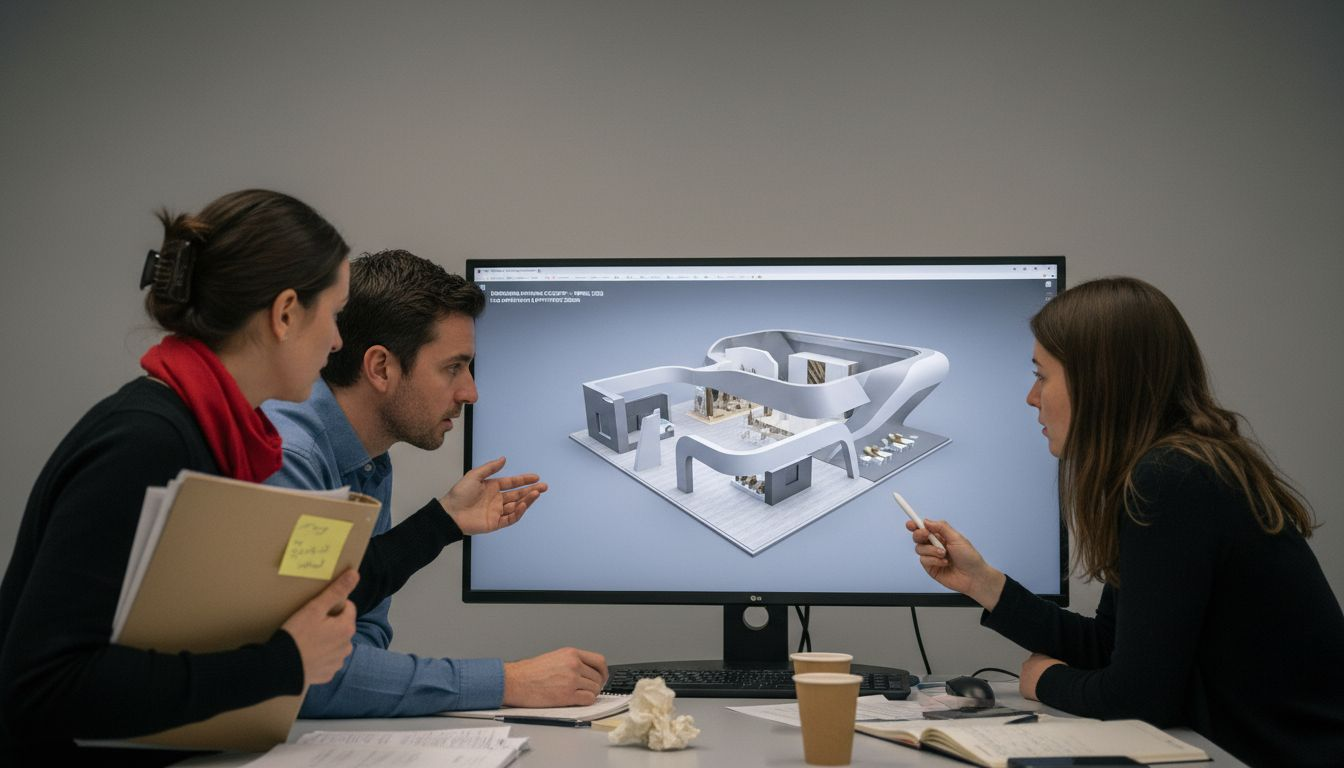
The collaborative advantages of 3D visualization extend across your entire team. Your internal marketing department, external design agency, fabrication specialists, and logistics coordinators all work from the same visual reference point. A designer in Berlin and a production manager in Amsterdam aren’t debating interpretations of technical drawings; they’re looking at an interactive 3D model they can rotate, zoom, and analyze together. This shared understanding dramatically reduces miscommunication and rework. Stakeholders can make informed decisions based on detailed visual context rather than abstract specifications. When your CEO asks whether the booth layout will accommodate the client entertainment area you promised, you show them directly in 3D instead of explaining verbally. They see the spatial constraints, understand the trade-offs, and approve the design with confidence.
Beyond planning efficiency, 3D visualization enhances the quality of your final result. You can test lighting scenarios before installation, adjusting angles and intensities to ensure products appear in their best light. You can preview material combinations to confirm your brand colors interact correctly. You can validate that sightlines work from the booth entrance, from 10 feet away, and from across the hall. This level of detail in the planning phase translates directly into exhibition outcomes. Attendees experience a thoughtfully designed space where every element serves a purpose, rather than a booth assembled from separate decisions that don’t quite work together. Research confirms that this optimization through visualization planning leads to better communication and improved exhibition outcomes across every stakeholder involved.
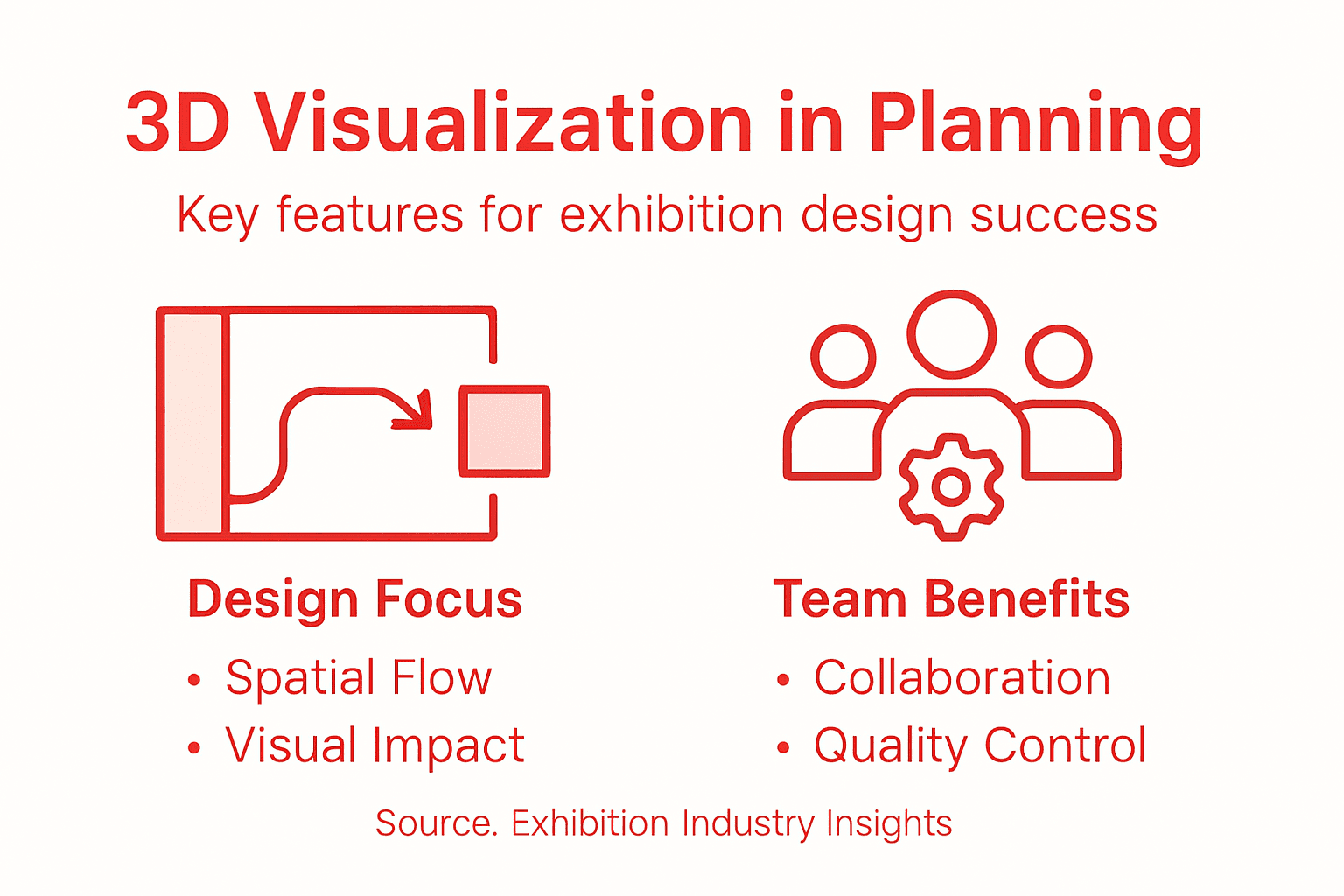
Below is a summary of critical 3D design features and how they impact exhibition outcomes:
| Feature | Purpose in Design | Impact on Results |
|---|---|---|
| Spatial Flow | Guides visitor movement | Maximizes booth traffic and engagement |
| Visual Hierarchy | Highlights brand/message | Boosts recall and product focus |
| Lighting Simulation | Tests light effects pre-show | Ensures displays look optimal |
| Material Visualization | Previews texture/compatibility | Reduces costly post-build fixes |
Pro tip: Involve your on-site installation team early in the 3D visualization process and ask them to identify any assembly challenges or logistical complications they foresee, catching practical issues before they become field problems.
Workflow: From Concept to Exhibit Floor
The journey from your initial exhibition concept to a finished booth on the exhibit floor follows a structured yet flexible process that relies heavily on 3D design collaboration. It starts with gathering your specific requirements: your marketing objectives, target audience, budget constraints, timeline, and brand positioning. This discovery phase shapes everything that follows. Your design team translates these requirements into initial spatial and thematic concepts, asking critical questions like where visitors should enter your booth, how they should move through it, and what moments deserve their attention. These concepts get rapidly converted into preliminary 3D models using CAD software, allowing you to visualize the direction before investing heavily in refinement. This early stage moves quickly because the goal is directional accuracy, not pixel-perfect detail.
Once you approve the preliminary direction, the iterative refinement phase begins. Your design team creates increasingly detailed 3D models that address practical, visual, and experiential objectives simultaneously. You review renders from multiple angles and vantage points, provide feedback, and the team adjusts proportions, materials, colors, and spatial relationships accordingly. This cycle repeats until the design reflects your vision and meets your functional requirements. The beauty of this approach is that changes happen in the digital environment where they’re fast and free. When you request that the demo station move three meters left to improve traffic flow, or that the color palette shift to better match your new brand guidelines, the designer implements the change and shows you the result within hours, not weeks. This exhibition stand design process transforms feedback into tangible improvements without construction delays.
Once you finalize the 3D design, the workflow moves into production and installation phases. Detailed technical drawings get extracted from the 3D model, specifying every material, dimension, electrical requirement, and assembly instruction for your fabrication team. Coordination with construction specialists ensures the physical build matches the digital specification precisely. Your fabrication partner references the 3D model throughout construction, catching any ambiguities before they become costly mistakes. Finally, your booth arrives at the trade show venue where installation teams use the 3D design documentation to assemble everything systematically. The entire process, from your first concept conversation to the moment your booth opens its doors, benefits from that single 3D source of truth that keeps every team aligned across months and multiple continents.
Pro tip: Request that your design partner provide regular 3D render updates at key decision points: initial concept, revised concept, design development, and final design phases, so you maintain clear visibility without unnecessary communication friction.
Common Pitfalls and How to Avoid Them
Many marketing managers invest in 3D design capabilities and then stumble because they overlook critical usability considerations. The most dangerous pitfall is prioritizing visual spectacle over practical functionality. Yes, that augmented reality feature looks impressive in renderings, but if visitors need five minutes of instruction to use it, or if the interface causes disorientation after 30 seconds of interaction, you’ve built an expensive distraction rather than an engagement tool. When integrating interactive technology or complex spatial layouts, poor ergonomic design and weak usability create friction that drives visitors away. Research confirms that inadequate attention to ease of interaction and spatial ergonomics reduces immersion and causes user discomfort. The solution is straightforward: balance your creative ambitions with ruthless usability testing. Before fabrication, have actual users interact with your 3D design in virtual reality. Watch where they struggle. Listen to their feedback. Adjust the interaction flow, button placement, and instruction clarity until the experience feels intuitive.
A second common mistake is designing in isolation from your actual booth dimensions and venue constraints. You fall in love with a stunning 3D render that assumes perfect lighting, spacious surroundings, and visitor sightlines from every angle. Then your booth lands in a corner of the Frankfurt trade show floor with fluorescent overhead lighting that renders your carefully chosen colors unrecognizable, and a neighboring booth that blocks the dramatic sightline you designed for. The avoidance strategy involves requesting venue floor plans and lighting specifications during your design phase, then incorporating those realities into your 3D visualization. Design for worst-case scenarios, not best-case rendering conditions. Test your booth design with the actual lighting conditions you’ll face. Consider sight lines from crowded positions where visitors stand shoulder to shoulder, not just open vantage points. This pragmatic approach ensures your physical booth performs as well as your digital model promised.
A third pitfall emerges during the fabrication phase when teams working from 3D designs make assumptions about details that weren’t explicitly specified. A color looks slightly different on screen than in physical material. A structural connection that appears seamless in 3D requires visible hardware in reality. A spatial measurement that works digitally doesn’t account for actual material thickness. Prevention requires detailed technical documentation extracted directly from your 3D model, paired with clear communication between your design team and construction specialists. Schedule a fabrication review meeting where your design team walks construction partners through the model, answering questions and clarifying ambiguities before work begins. This investment in clarity prevents expensive rework and ensures your physical booth matches the design intent.
Pro tip: Conduct user testing with your 3D design in virtual reality before finalizing fabrication, specifically testing interactive elements and ergonomic considerations to catch usability issues while changes remain digital and inexpensive.
Elevate Your Exhibition Impact with Expert 3D Stand Design Solutions
Maximizing the power of 3D design is essential to creating an exhibition stand that not only looks impressive but also delivers a seamless visitor experience. If you want to solve challenges like poor spatial flow, ineffective visual hierarchy, or underwhelming engagement, Adam Expo Stand offers tailored solutions that align perfectly with these goals. Our expertise in 3D visualization ensures your booth layout, lighting, and interactive elements are optimized long before fabrication begins, reducing costly errors and bringing your brand narrative to life with precision.
Discover how our comprehensive services—from modular and custom structures to technology-integrated displays—address your specific needs with flexibility and impact. By choosing Adam Expo Stand, you gain a partner committed to meticulous project management and on-site support across Europe. Don’t let design pitfalls hold you back. Experience the advantage of working with professionals who translate your vision into immersive, effective exhibition environments that captivate attendees and boost brand recognition. Start your journey today by exploring our full range of exhibition stand design services and see how 3D design can transform your next trade show presence.
Frequently Asked Questions
What is the importance of 3D design in exhibition planning?
3D design is essential in exhibition planning as it allows for the visualization of spatial flow, visual hierarchy, and interaction pathways, enabling designers to optimize the visitor experience before physical construction begins.
How can 3D visualization improve visitor engagement at exhibitions?
3D visualization enhances visitor engagement by creating immersive environments that allow attendees to interact with displays and content, leading to higher information retention and brand recall.
What are the main types of 3D exhibition stand designs?
The main types of 3D exhibition stand designs include modular systems for flexibility, custom structural designs for originality, and technology-integrated interactive displays for enhancing engagement.
How does the iterative refinement process work in 3D design for exhibitions?
The iterative refinement process involves creating detailed 3D models based on initial concepts, allowing for adjustments based on feedback regarding visuals and functionality until the design meets all requirements effectively.