What Is a Hybrid Exhibition Stand – Unlocking Trade Show Impact
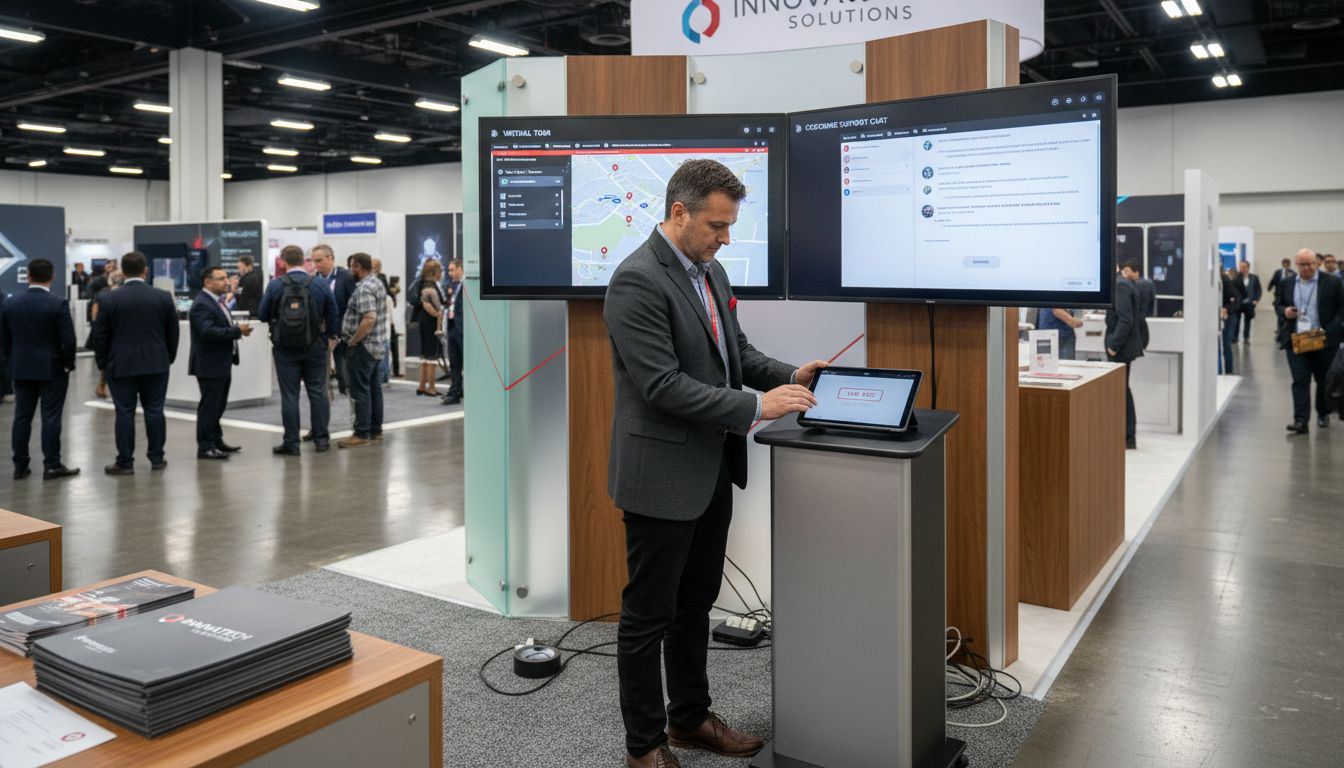
Standing out on the crowded floors of international trade shows can feel challenging for European brands looking to connect with a global audience. The move toward hybrid exhibition stands is changing how companies interact with both physical and remote attendees, blending on-site experiences with immersive virtual technologies. Embracing these integrated platforms lets you deliver synchronized content, real-time engagement, and robust data insights for stronger brand visibility and deeper participation across borders.
Table of Contents
- Defining Hybrid Exhibition Stands In 2026
- Types And Core Features Of Hybrid Stands
- How Hybrid Stands Enhance Brand Engagement
- Cost Structure And Sustainability Considerations
- Hybrid Vs. Traditional And Digital Exhibits
- Choosing The Right Hybrid Stand For Your Event
Key Takeaways
| Point | Details |
|---|---|
| Hybrid Exhibition Stands Are Essential | They integrate physical and digital elements, enabling engagement with both in-person and remote attendees simultaneously. |
| Data-Driven Insights | Hybrid stands provide comprehensive analytics, allowing businesses to understand attendee behavior and optimize engagement. |
| Cost-Effective and Sustainable | They significantly expand audience reach without proportional cost increases while also reducing travel expenses and carbon emissions. |
| Flexible Designs for Diverse Audiences | Properly designed hybrid stands accommodate different audience preferences and learning styles, enhancing overall brand connectivity. |
Defining Hybrid Exhibition Stands in 2026
A hybrid exhibition stand blends physical and digital elements into one cohesive experience, allowing your brand to engage attendees both in person and online simultaneously. Think of it as breaking down the walls of your booth. Instead of reaching only the visitors walking past your stand on the trade show floor, you’re now reaching decision-makers thousands of kilometers away through live streaming, virtual reality, and augmented reality technologies.
The core definition centers on integrated platforms that connect offline presence with online digital tools. This means visitors at the physical venue can interact with your brand while remote participants join from their offices, creating a truly borderless exhibition. Both groups see the same product demonstrations, access the same content, and participate in real-time conversations through synchronized digital channels.
What makes 2026 different from previous years is maturity and acceptance. The pandemic forced rapid adoption of hybrid formats, but companies discovered genuine advantages that stick around. Flexibility in how audiences participate. Cost efficiency from extended reach without proportional infrastructure increases. Sustainability benefits from reduced travel requirements. These aren’t temporary workarounds anymore—they’re strategic business decisions that types of exhibition stands now incorporate as standard features.
Your hybrid stand captures significantly more data than traditional formats. You track physical visitor journeys through motion sensors and QR codes while monitoring digital attendee behavior through analytics dashboards. This dual-layer information reveals which booth elements genuinely resonate, how long people engage with specific content, and where they drop off—insights that pure physical booths simply cannot provide.
The technology enabling this shift includes live streaming capabilities that broadcast your presentations to global audiences, VR environments that let remote attendees explore your stand layout interactively, and AR features that overlay product information onto devices attendees hold. These aren’t novelties—they’re now foundational components of modern trade show strategy for European companies competing on an international stage.
Pro tip: When planning your 2026 booth, identify which of your target audiences exist only digitally and which require physical presence, then design your hybrid stand to serve both groups equally rather than treating the digital component as an afterthought.
Types and Core Features of Hybrid Stands
Hybrid stands come in several configurations, each designed for different business objectives and audience sizes. The most common type is the livestream-enabled booth, which broadcasts everything happening at your physical stand to remote viewers in real-time. Think product demos, panel discussions, and Q&A sessions happening simultaneously for both in-person and online attendees. This format works exceptionally well for product launches or technical presentations where global visibility matters.
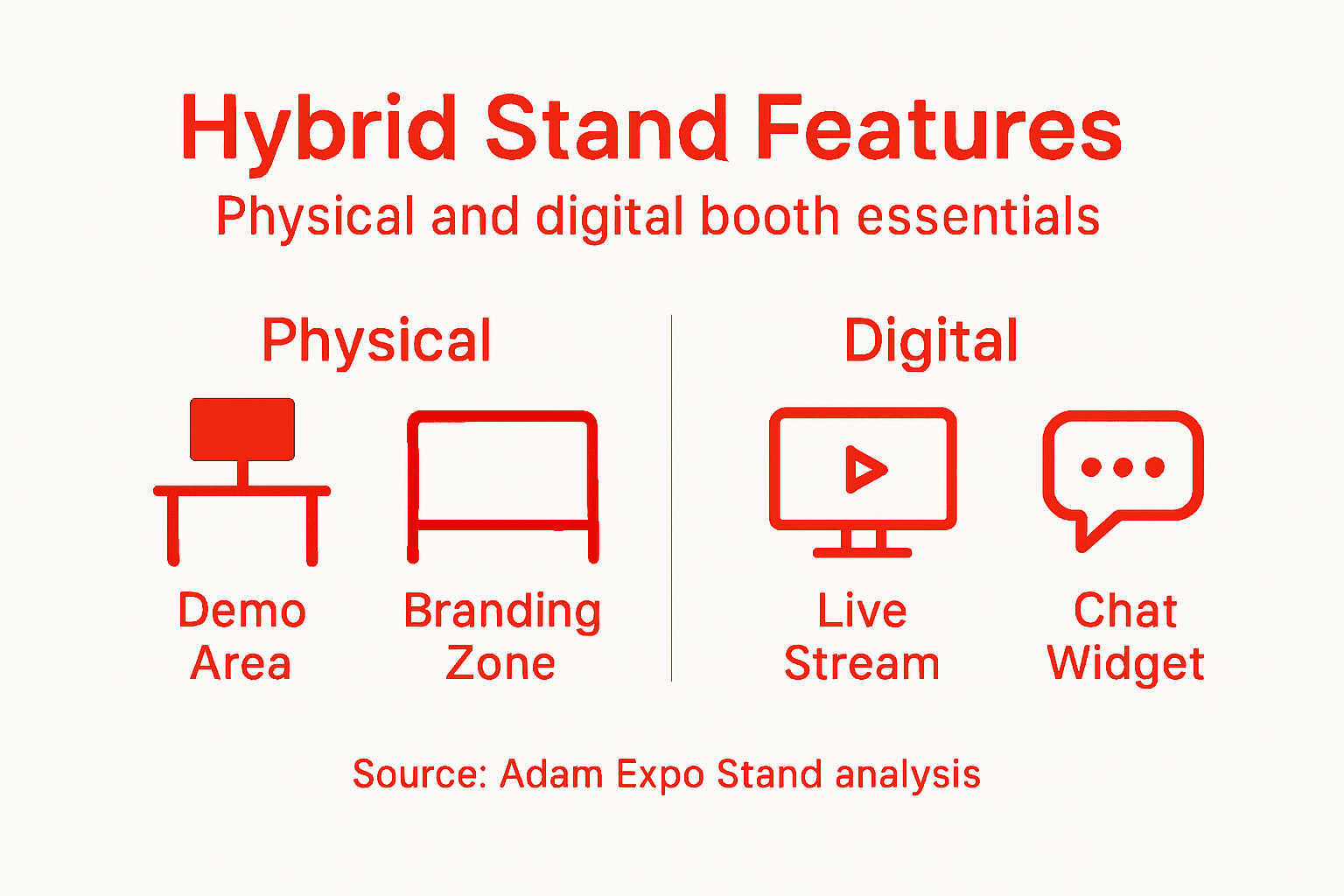
Another popular configuration is the VR exploration stand, which invites remote participants to navigate a virtual representation of your booth environment. Visitors can explore product details, access downloadable resources, and interact with your team through avatars. European companies often use this approach when targeting distributed teams across multiple countries who cannot travel to central trade shows.
The hybrid interactive stand combines booth presence with digital engagement stations scattered throughout the physical space. Physical attendees use tablets or touchscreens to unlock exclusive digital content, participate in virtual polls, or connect with remote specialists. Meanwhile, online participants see the same content feeds and contribute to conversations, creating a genuinely integrated experience rather than parallel activities.
Core Features That Matter
Every effective hybrid stand shares certain foundational features. Synchronized content delivery ensures both physical and digital audiences receive identical information at the same moment. Real-time interaction capabilities let remote participants ask questions, submit feedback, and engage with booth staff without delays. Data integration systems collect insights from both environments into unified analytics dashboards, showing you complete attendance patterns and engagement metrics.
Another critical feature is flexible participation options. Remote attendees shouldn’t feel like second-class participants. They need quality video feeds, clear audio, the ability to request product demos, and genuine access to your specialists. Physical attendees equally need engaging reasons to visit your booth rather than simply watching the livestream from their hotel room.
Mobility and adaptability round out the essentials. Your stand should accommodate unexpected changes, from technical issues to last-minute attendance surges. Custom exhibition stands designed with hybrid functionality built in from the start handle these challenges far better than retrofitted traditional booths.
Below is a summary of key features that define an effective hybrid stand:
| Core Feature | Business Impact | User Experience Benefit |
|---|---|---|
| Synchronized content delivery | Consistent messaging across audiences | Simultaneous updates for all |
| Real-time interaction | Immediate feedback from prospects | Instant Q&A and engagement |
| Data integration platforms | Comprehensive analytics for marketing | Tailored follow-up actions |
| Flexible participation modes | Wider audience inclusion | Custom engaging experiences |
Pro tip: Prioritize audio quality above all else—remote participants will forgive modest video issues but will abandon a booth with poor sound within seconds, so invest in professional microphone arrays and backup audio systems.
How Hybrid Stands Enhance Brand Engagement
Hybrid stands transform how brands connect with audiences by removing the friction that typically limits booth interactions. A physical visitor can spend ten minutes exploring your booth. A remote participant can spend three hours navigating your VR environment, rewatching product videos, and downloading technical specifications. This flexibility means your brand captures engagement from people in different time zones, with different schedules, and different comfort levels with in-person events.
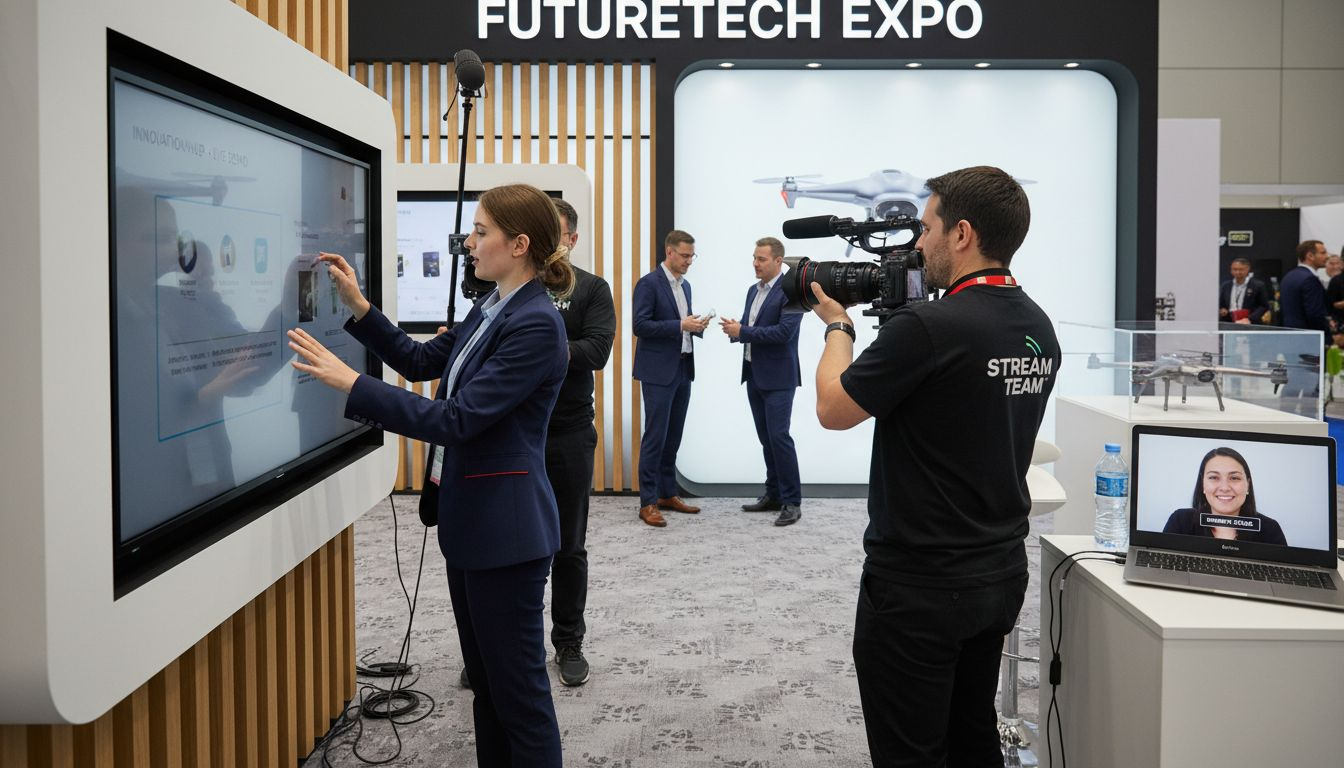
The real magic happens when you merge physical and digital interactions into seamless experiences. When a visitor at your booth demonstrates a product using AR technology, remote participants watching the livestream see the exact same augmented visualization on their screens. They ask questions in real-time. Your booth staff responds to both the person standing in front of them and the distributed audience online. This creates genuine community around your brand rather than isolated individual touchpoints.
Personalization becomes exponentially more powerful with hybrid formats. Big data analytics track which product demonstrations draw the longest attention from physical visitors, which digital resources remote participants download most frequently, and where engagement drops off. Armed with this intelligence, you tailor future communications to each segment. A prospect who watched your technical deep dive video three times receives different follow-up content than someone who briefly sampled your general product overview.
Hybrid stands also accommodate different learning styles and participation preferences. Some prospects learn best through hands-on interaction with physical products. Others prefer observing demonstrations, asking questions via chat, and absorbing information at their own pace. Still others want immersive VR exploration without pressure from booth staff. Your hybrid approach serves all three groups simultaneously, dramatically expanding your addressable audience.
The stronger brand connections emerge because people engage on their own terms. A prospect from Stockholm can explore your booth at 2 AM when inspiration strikes. A distributed team across Germany can attend together without coordinating travel. A busy C-suite executive can participate without blocking entire days. When engagement barriers drop, participation increases, and deeper relationships form naturally.
Strategic event branding ideas ensure your brand messaging remains consistent across physical and digital environments, reinforcing recognition and recall at every interaction point.
Pro tip: Designate a dedicated digital moderator during your booth events to manage remote participant questions, monitor engagement metrics, and ensure online attendees receive equal attention and professional responses as physical visitors.
Cost Structure and Sustainability Considerations
Hybrid stands require upfront technology investments that traditional booths don’t. You need livestreaming equipment, reliable internet connectivity, VR development platforms, and staff trained to manage digital environments alongside physical interactions. These costs vary dramatically based on complexity. A basic livestream setup costs significantly less than a fully immersive VR experience with professional 3D modeling.
However, the math shifts when you calculate cost per engagement. Instead of reaching 500 in-person visitors at a single trade show, you now reach 500 physical attendees plus 2000 remote participants across multiple countries. Your booth investment now serves 2500 people instead of 500. That’s a 400% increase in addressable audience without proportional cost increases. Traditional exhibition expenses drop per participant when you distribute infrastructure costs across larger crowds.
Travel expenses decrease dramatically for attendees and team members. Remote participation eliminates flights, hotels, and meals for distributed teams. In Europe, where companies span from Portugal to Poland, hybrid formats reduce participant travel by 60% to 80%. That translates to lower carbon emissions, reduced costs for attending companies, and improved accessibility for people with mobility constraints.
Long-Term Sustainability Benefits
Reusable modular booth components, when designed for hybrid capability, provide extended value across multiple events. A stand built this year remains relevant in 2025 and 2026 as digital technologies evolve. You’re not discarding the physical infrastructure annually. Digital-first designs mean fewer printed materials, less packaging waste, and minimal single-use exhibition components.
Hybrid formats also reduce venue-related environmental impact. Smaller physical booth footprints are possible when remote participants handle portions of engagement. This means venues can accommodate more companies using less total space, reducing energy consumption for climate control and lighting across entire exhibition halls.
The sustainability advantage extends to your supply chain. You purchase less physical inventory for product demonstrations when remote participants explore digital prototypes. Fewer physical samples need manufacturing, packaging, and transportation across European logistics networks.
Pro tip: Request detailed pricing breakdowns from exhibition stand providers that separate technology costs from physical construction, allowing you to scale digital features independently based on your budget and audience expectations rather than accepting all-or-nothing hybrid packages.
Hybrid vs. Traditional and Digital Exhibits
Traditional physical booths dominated trade shows for decades because they work. Visitors walk past your stand, shake hands with your team, touch products, and make snap decisions about your brand. There’s authenticity in face-to-face interaction that digital formats struggle to replicate. But traditional booths have hard limits. You reach only people who attend that specific event in that specific city on those specific dates.
Purely digital exhibits emerged as the pandemic forced remote participation. Companies streamed presentations, hosted virtual booth tours, and took orders through video calls. Digital-only formats dramatically expand geographical reach and eliminate travel barriers. The problem? They lack tangibility. Prospects can’t feel product quality. Team chemistry doesn’t translate through screens. Decision-makers often deprioritize online events compared to in-person experiences.
Hybrid exhibits solve the core weakness of each approach while preserving their strengths. You maintain the authentic human connection and product experience of traditional booths while simultaneously reaching global audiences without geographical constraints. A prospect in Berlin experiences genuine booth interaction while a prospect in Singapore explores the same booth virtually.
Here’s the practical difference: Traditional booths cost roughly the same regardless of attendance. Digital-only exhibits have minimal physical costs but struggle to drive qualified leads. Hybrid exhibits require higher initial investment but deliver exponential return because they serve multiple audiences simultaneously. Your technology infrastructure becomes an asset that compounds value across events.
Here’s a comparison of traditional, digital, and hybrid exhibition stands and their impact:
| Exhibit Type | Reach & Accessibility | Tangibility & Engagement | Cost Structure |
|---|---|---|---|
| Traditional Booth | Limited to venue & attendees | High, with physical products | Fixed regardless of reach |
| Digital-Only Stand | Global, unrestricted by venue | Low, lacks physical contact | Minimal physical expenses |
| Hybrid Stand | Combines local and remote | Blended, immersive experience | Scalability per audience |
Attendee behavior differs significantly across formats. Traditional visitors make quick decisions under social pressure. Digital participants take their time, research thoroughly, and compare options. Hybrid attendees choose their engagement style. Some want high-touch demos. Others prefer asynchronous exploration. Smart hybrid stands accommodate all three preferences, converting prospects who would abandon purely traditional or purely digital approaches.
The impact of display technology on modern exhibitions demonstrates how integrated digital elements transform visitor experiences compared to static traditional setups, making hybrid approaches increasingly essential for competitive advantage.
Pro tip: Don’t treat your hybrid stand as traditional plus digital as an afterthought; instead, design the physical booth and digital experience simultaneously so each component enhances the other rather than competing for attention and resources.
Choosing the Right Hybrid Stand for Your Event
Selecting a hybrid stand starts with understanding your specific event objectives. Are you launching a product globally? Building brand awareness across distributed markets? Generating qualified leads from specific industry verticals? Your primary goal shapes every decision about technology, layout, and content strategy. A product launch benefits from immersive VR experiences and livestreamed keynotes. Lead generation prioritizes data capture and personalized follow-up systems.
Next, consider your audience composition. What percentage of prospects can attend physically versus those who need digital access? European companies often find 40% physical attendance and 60% remote participation in international events. This split changes your booth design priorities. Heavy digital participation means investing more in screen quality, interactive content, and remote engagement tools. High physical attendance means prioritizing in-person experience and product touchpoints.
Venue logistics matter significantly. Some trade show halls have unreliable internet connectivity. Others restrict certain technologies. Understand your venue’s technical infrastructure before committing to bandwidth-heavy livestreaming or VR applications. A smaller, more stable venue might support sophisticated digital experiences better than a massive convention center with inconsistent connectivity across booth locations.
Key Selection Criteria
Branding consistency is non-negotiable across physical and digital spaces. Your booth colors, messaging, and visual hierarchy must feel identical whether someone experiences them in person or through a screen. This alignment reinforces brand recognition and creates professional credibility.
Choose modular stand configurations that allow you to adapt booth size, layout, and technology integration across different events without complete reconstruction. Modular flexibility means you invest once and reconfigure multiple times as events and audiences change.
Assess post-event analytics capabilities before selecting your stand provider. Which data matters most to your business? Foot traffic patterns? Digital engagement duration? Lead contact information? Ensure your hybrid stand captures and reports these metrics in formats your team actually uses for sales or marketing follow-up.
Finally, evaluate assembly timelines and support requirements. Complex hybrid stands demand technical expertise on-site. Budget for your provider’s on-site staff support during setup and the event itself rather than assuming your internal team can manage technology troubleshooting alongside marketing activities.
Pro tip: Start with a small-scale hybrid pilot at a regional event before committing to major international trade shows, allowing you to test technology, train your team, and gather real data about what engagement features actually drive results for your specific industry.
Elevate Your Trade Show Impact with Custom Hybrid Exhibition Solutions
The challenge highlighted in the article centers on delivering seamless, engaging experiences to both physical visitors and remote attendees through innovative hybrid exhibition stands. If you want to overcome limited geographical reach, provide synchronized content, and gather comprehensive data on visitor engagement you need a partner skilled in integrated booth design and digital engagement technologies. Adam Expo Stand specializes in creating custom and modular hybrid booths crafted to connect multiple audiences simultaneously while maintaining your brand’s consistency and professionalism.
Our turnkey services include advanced 3D design visualization and expert on-site assembly ensuring that your hybrid stand delivers flawless audio and visual quality essential for remote participation. We understand that flexible participation modes and real-time interaction capabilities are not optional but core to modern trade shows. With our sustainability-focused modular stands and rental solutions you reduce environmental impact while amplifying event accessibility across Europe and beyond.
Explore how Adam Expo Stand can transform your trade show presence today by visiting our main site. Discover tailored solutions that integrate perfectly with your event objectives by learning more about our custom exhibition stands. Are you ready to unlock greater brand engagement and measurable success from your next event? Contact us now and take the first step toward a powerful hybrid exhibition experience.
Frequently Asked Questions
What is a hybrid exhibition stand?
A hybrid exhibition stand combines physical and digital elements to create an interactive experience for both in-person and online attendees. It allows brands to engage a wider audience by integrating live streaming, virtual reality, and augmented reality technologies.
How can hybrid stands enhance audience engagement at trade shows?
Hybrid stands remove barriers to engagement by allowing physical visitors to interact with products while remote participants enjoy immersive experiences. They cater to different learning styles and preferences, ensuring more opportunities for meaningful interactions.
What are the key components of an effective hybrid exhibition stand?
Effective hybrid stands typically feature synchronized content delivery, real-time interaction capabilities, data integration systems for comprehensive analytics, and flexible participation options for both in-person and remote attendees.
How do hybrid exhibition stands benefit businesses in terms of cost and sustainability?
Hybrid stands can reduce overall participant travel costs, increase audience reach without proportional expense, and promote sustainability by using fewer physical materials and minimizing carbon footprints. Their modular components can also be reused across multiple events.